“Do as I Say, Not as I Do”: Understanding Equalising Behaviour in PDA
What in the world is equalising behaviour, you may be asking? It certainly was not a term I had heard until relatively recently. Yet once I began reading about it in the context of PDA, it helped make sense of patterns we had lived with for years. It has also changed how we approach some situations at home. Don’t get me wrong, it’s not a magic solution, but understanding what is driving certain behaviours means it’s easier to respond in a more constructive way.
What is equalising behaviour?
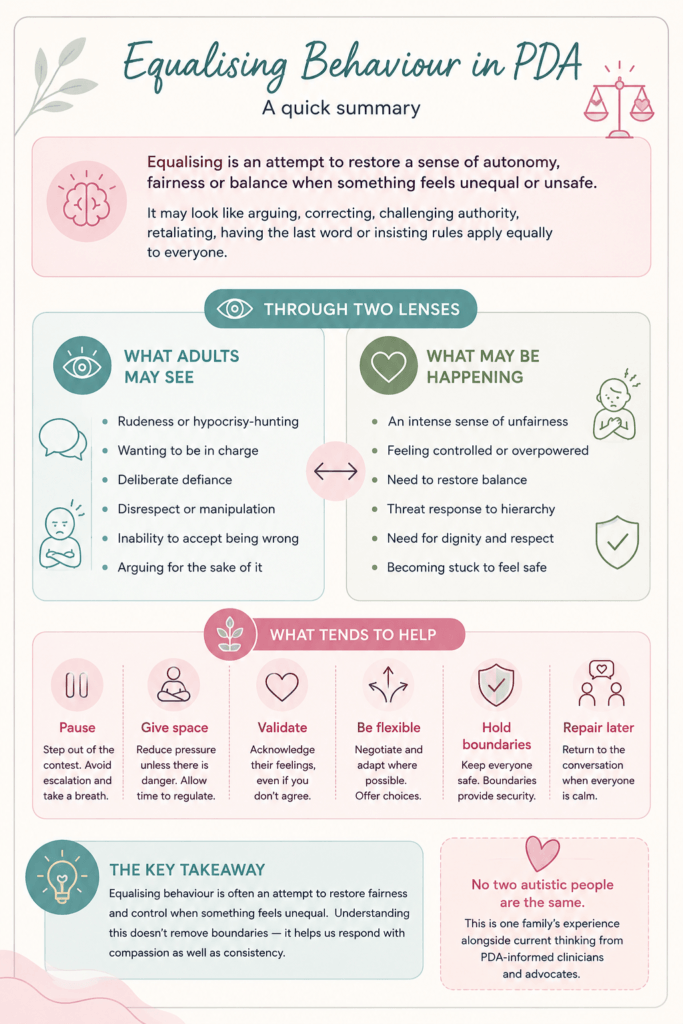
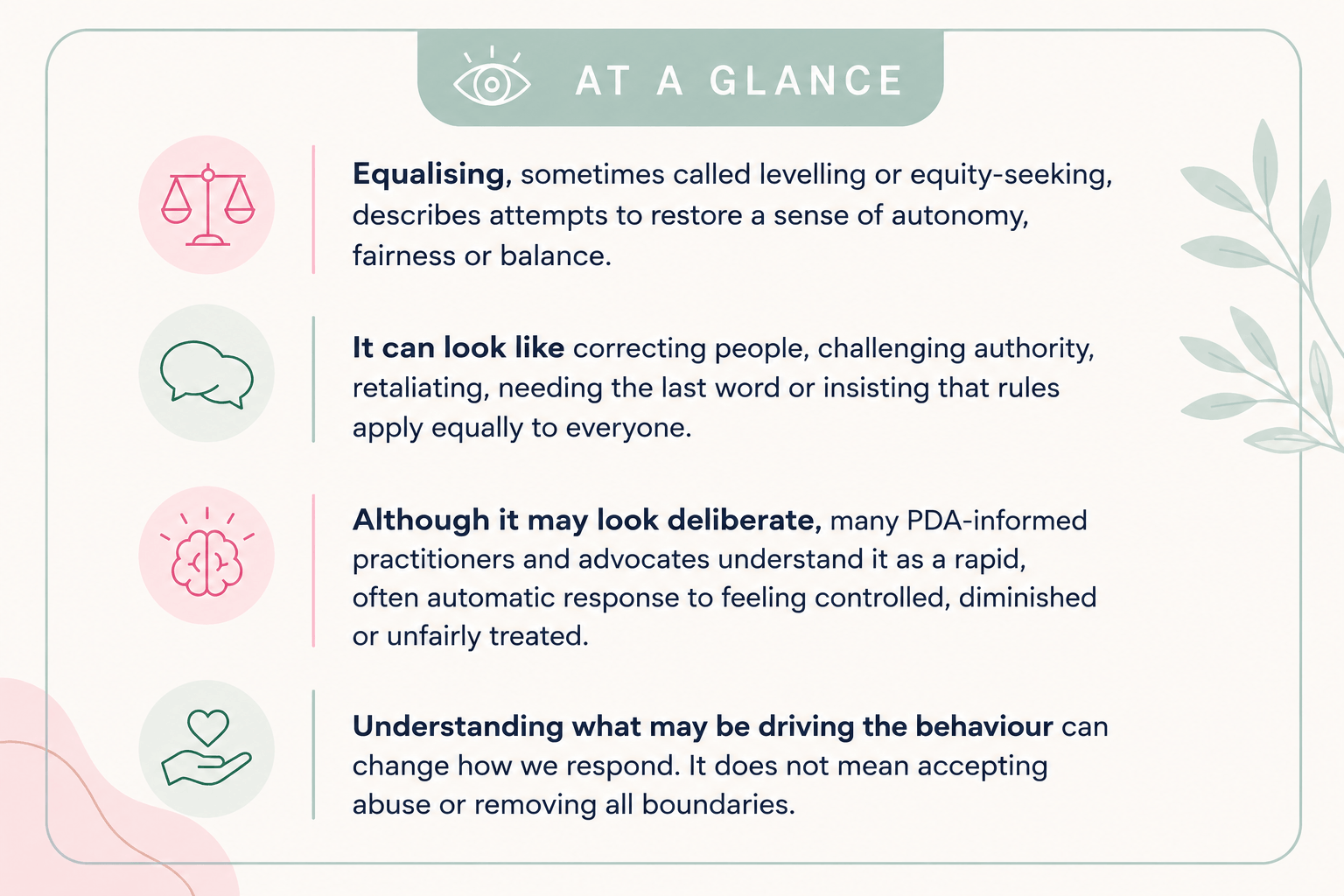
Equalising describes an attempt to restore a sense of control, autonomy, fairness or balance when a situation or relationship feels unequal.
The PDA Society describes equalising, also known as levelling, as behaviour that may arise when a PDA person senses unfairness or an imbalance within a relationship or interaction. The aim, consciously or otherwise, may be to “level the playing field” and reduce the distress associated with feeling controlled or dominated.
It can take many forms, including:
- challenging authority
- correcting other people
- insisting on having the last word
- pointing out hypocrisy or inconsistencies
- becoming controlling or bossy
- insisting that rules are applied identically to everyone
- trying to provoke the other person into feeling equally upset
- rejecting help that appears to place someone else in a position of power
Sometimes it isn’t obvious. A child may correct a tiny detail, position themselves as the expert or micromanage how someone else completes a task. At other times it can be much more overt. They may shut a conversation down, follow someone around continuing an argument, damage something, retaliate verbally or lash out at the person with whom they feel safest.
A child correcting a teacher, refusing to concede a point or demanding that a rule be applied equally to their sibling may not simply be trying to cause trouble. Something may have registered as unfair, controlling, humiliating or unsafe, and the behaviour may be an attempt to restore balance and lower anxiety.
That does not make every response reasonable or acceptable. But it gives us a more useful starting point for managing the situation.
“Do as I say, not as I do”
Most children notice adult hypocrisy. A child with a PDA profile may appear almost exquisitely sensitive to it. We may tell them not to interrupt while interrupting them. We may ask them to speak respectfully while using a sharp or irritated tone ourselves. We may insist that they apologise while rarely acknowledging our own mistakes. We may say that shouting is unacceptable, then raise our own voice when they do not comply.
We may expect them to answer our questions immediately while reserving the right to say, “Not now,” when they approach us. From an adult perspective, these situations are not necessarily equivalent. Adults carry responsibilities that children do not, and family life cannot always operate as a completely equal democracy. However, to a young person who is highly sensitive to hierarchy and unfairness, “Do as I say, not as I do” can feel intolerable.
The problem may not be the rule itself. It may be that the rule appears to confirm that one person holds all the power while the other is expected to submit.
This can be particularly difficult at school, where adults may interpret questioning, correcting or challenging an instruction as disrespectful regardless of whether the young person is factually correct. There is an important nuance here. We have never wanted to teach our son that authority figures are automatically right, particularly when he has noticed a genuine inconsistency. That is a complicated lesson for any teenager, let alone one whose nervous system may already be reacting strongly to perceived inequality as well as baseline challenges with social interactions.
Where does the idea of equalising come from?
Equalising is not currently a formally defined psychological or diagnostic term. It is language that has emerged largely from PDA-informed parents, practitioners and autistic advocates trying to describe a pattern they repeatedly observe.
Dr Casey Ehrlich of At Peace Parents describes equalising as a reflexive response through which a PDA child, teenager or adult attempts to return a dysregulated system to a place of safety.
Autistic PDA advocate Kristy Forbes has discussed related concepts using the language of levelling and equity-seeking. The PDA Society now also uses the terms equalising and levelling in its guidance.
These descriptions may be extremely meaningful to families. However, they should not be confused with established diagnostic criteria or a mechanism that has been demonstrated through controlled scientific research. As far as I can establish, equalising itself has received very little direct attention within peer-reviewed literature which is a shame.
What equalising has looked like in our family
During meltdowns when he was younger, my son would sometimes follow me around the house, repeating the same phrase or request for hours. It was genuinely difficult not to engage. My instinct was to explain, reason and defend my position. Unfortunately, every explanation created another point to argue against. At times, I had to lock myself in the bathroom simply to place a physical boundary between us and allow the situation to de-escalate.
As a teenager, the pattern has shifted. He may now shut down any attempt at conversation completely: “Stop talking” or “Go away” repeated over and over with increasing annoyance. Sometimes he gives me a countdown to leave his room when I have only gone in to ask what he would like for lunch. I used to feel that I had to challenge this immediately. Surely allowing a child to speak to a parent like that meant condoning disrespect? I no longer see it quite so simply especially as standing my ground inevitably leads to escalation.
I have learned that you cannot meet rigidity with greater rigidity and expect a good outcome. When he is highly activated, insisting that he speak appropriately before I leave usually creates a larger confrontation rather than teaching anything meaningful.
So, where it is safe to do so, I give him space.
That does not mean the interaction never matters. It means I recognise that there is a right time for these conversations and a time when they simply will not be processed, however calmly I believe I am delivering them. When he is regulated, we are far more likely to be able to talk about what happened, how it affected other people and what might help next time. These times of regulation can be few and far between at challenging times and patience is a necessity. The parental instinct is to want to sort things out, patch things up and make everything right. However, this in itself can become another intolerable demand
Equalising between siblings
Sibling relationships can make this especially complicated. A child may closely monitor whether their brother or sister has been asked to complete the same task, received the same consequence or been given the same amount of something. In our house our PDA child often feels unfairly treated and that different rules apply between him and his sibling.
Parents, meanwhile, know that fair does not always mean identical. One child may need more supervision. Another may have different needs, developmental abilities or privileges associated with age. There may be perfectly valid reasons for treating two children differently, but those reasons will not necessarily reduce the immediate sense of injustice.
Equalising can also place siblings in a difficult position. They may feel that family decisions revolve around avoiding one child’s distress, or that their own feelings are expected to wait. Understanding PDA must never mean overlooking the wellbeing of brothers and sisters. Their feelings deserve acknowledgement too. They need time with their parents, permission to express anger or sadness, and reassurance that adapting our approach does not mean their needs matter less.
Through Two Lenses
What adults may see
- rudeness
- arguing for the sake of it
- hypocrisy-hunting
- wanting to be in charge
- manipulating a situation
- deliberate defiance
- an inability to accept being wrong
- disrespect for parents or teachers
What may be happening underneath
- an intense sense of unfairness
- feeling embarrassed, criticised or diminished
- an urgent need to rebalance the relationship
- fear of being controlled
- difficulty tolerating another person holding authority
- a need to regain dignity after feeling powerless
- a rapid threat response rather than a considered choice
- becoming stuck until the perceived imbalance has been corrected
Both lenses matter.
The behaviour may be distress-driven, and it may still hurt other people. Understanding the first does not require denying the second.
So What Helps?
Step out of the contest
Once an interaction has become a battle over who is right, who is in charge or who gets the final word, continuing to argue rarely produces insight. You do not have to concede the entire issue. Sometimes it is enough to step away and stop engaging.
You might say:
“I can see this feels unfair. We do not need to solve it right now.”
“I’ve heard your point. I’m going to give us both some space.”
Give space rather than pressure
Unless there is an immediate safety concern, allowing a young person to retreat and regulate is often more helpful than insisting the conversation is completed. This can feel uncomfortable because the issue remains unresolved. However, a resolution forced during high arousal is rarely a meaningful one.
Validate the experience without agreeing with everything
Validation does not mean declaring that the young person’s interpretation is objectively correct. It means recognising the feeling or perspective underneath it.
For example:
“I understand why that looked inconsistent.”
“I can see why it felt as though you were being singled out.”
“You expected the same rule to apply to everyone.”
You can then hold a boundary:
“I understand why you are angry but I won’t let you hit me.”
“You can tell me that it feels unfair but calling your brother names upsets him”
Acknowledge your own mistakes
Nothing inflames a sense of inequality quite like an adult refusing to admit when they have got something wrong. A sincere apology does not undermine parental authority. In my experience, its a good strategy to de-escalate situations and level things up.
“I got that wrong and I’m sorry, I should have trusted you.”
“My tone was wrong. I’m sorry.”
“I made that decision too quickly. Let me reconsider it.”
This does not mean apologising simply to end every confrontation. It means modelling the accountability we ask of our children.
Explain the difference between equal and fair
Where possible, explain why expectations differ.
“Your brother has a different bedtime because he is younger.”
“I’m asking you to do this because it relates to your safety, not because I think you are less important.”
The explanation may not be accepted in the moment, but transparency can reduce the sense that rules are arbitrary.
Offer genuine choices
Choices need to be real rather than disguised instructions.
Instead of:
“Would you like to tidy your room now?” when “no” is not actually an acceptable answer,
try:
“The room needs enough floor space for us to walk safely. Would you rather move the clothes or the boxes first?”
Even then, a choice may still feel like a demand. It is a tool, not a guarantee.
Negotiate where you genuinely can
Not every boundary is equally important.
It can help to ask ourselves:
- Is this about safety or simply convention?
- Does it truly need to happen now?
- Am I holding this line because it matters, or because I feel challenged?
- Can the goal stay the same while the route changes?
- Is there room for the young person to suggest another solution?
Flexibility is not the same as having no boundaries. It is recognising that rigid insistence may increase anxiety without improving the eventual outcome.
Return to the issue later
A calm follow-up might sound like:
“Yesterday became difficult for both of us. I’m not going to lecture you, but I would like us to think about what might help next time.”
“What did you think was unfair?”
“What could I have done differently?”
“What do you think you could do if that happens again?”
The aim is collaborative problem-solving rather than extracting an apology on demand.
What if my child is factually wrong?
This is difficult because correcting them directly may intensify the need to defend their position. My son rarely see’s things from another person’s perspective and can be adamant and unswervingly wrong about things. No amount of discussion is going to resolve this.
Ask yourself whether the factual point needs to be settled immediately.
Sometimes it may be enough to say:
“We remember that differently.”
“I’m going to check before we decide.”
“You may be right about part of that. I see another part differently.”
Not every inaccurate statement needs to become a courtroom argument. When accuracy genuinely matters, use neutral information where possible rather than turning it into a contest between your authority and theirs. We have found indirectly fact checking by agreeing to ask ChatGPT can help resolve an issue without the feeling of threat.
What if they need the last word?
Sometimes pursuing the final word only creates an endless loop. My son is the most single minded determined person I know and will not back down.
Allowing the conversation to end without answering every final comment does not mean the young person has “won.” It means you have chosen not to continue an unproductive interaction. A parent does not have to demonstrate authority by answering every challenge.
What if they speak to me abusively?
Understanding equalising does not mean accepting threatening, degrading or violent behaviour.
Safety comes first.
In the moment, this may mean leaving the room, moving siblings away, reducing language, removing dangerous objects or seeking additional support. A boundary can be brief:
“I will talk when we are both safe.”
“I’m moving away because I will not stay while I’m being hit.”
“I know you are angry. I won’t allow you to threaten your brother.”
The later conversation should focus not only on consequences, but also on what happened before the behaviour, what signs were missed and what alternative route might be possible next time. Where aggression is frequent, escalating or making family members feel unsafe, families deserve professional support. It should not simply be absorbed as part and parcel of parenting a neurodivergent child.
Am I rewarding the behaviour by backing away?
This is probably one of the questions parents ask themselves most. Traditional behavioural advice may tell us that withdrawing a demand after escalation reinforces the behaviour. Real family life is more complicated.
Sometimes backing away is necessary because the young person is no longer able to process the request safely. De-escalating a crisis is not the same as deciding that the original issue no longer matters. The expectation can sometimes be revisited later, adapted or achieved in another way.
The bigger question is not simply, “Did they get out of the demand?”
It is:
“What helps this young person remain regulated enough to participate, learn and preserve the relationship?”
Does understanding this make us too permissive?
It can be difficult to find the balance between accommodation and boundaries. Too much rigidity may create repeated crises. Too little structure can leave the whole family feeling unsafe and uncertain. The aim is not endless permissiveness. It is thoughtful flexibility.
Some boundaries, particularly those involving safety, violence or the rights of other family members, must remain. Other expectations are negotiable, can be delayed, reframed or quietly dropped because they are not worth the human cost of enforcing them.
No family will get that balance right every time. We certainly do not.
My perspective
One of the hardest parts of parenting a child with a PDA profile is that the behaviour can look entirely intentional. It is easy to wonder whether he is manipulating a situation or simply choosing not to cooperate, rather than genuinely being unable to manage the interaction in that moment.
Learning about equalising has not made every day easier. It has not been a magic wand. It has, however, helped me remain more compassionate through the countdowns, the anger, the correcting and the days of distance.
It reminds me to look beneath the behaviour and ask what has felt unfair, humiliating, controlling or unsafe. Sometimes the answer is obvious. Sometimes I still have absolutely no idea.
There are also times when I understand what may be driving the behaviour but remain hurt, angry or exhausted by it. Parents cannot remain endlessly regulated while someone else is shouting, following us or rejecting every attempt at connection. Understanding our child does not mean disappearing ourselves. It means trying to hold two truths at once: he may be struggling, and the people around him may be struggling too.
That, for me, is the heart of the Two Lenses approach.
The main takeaway
Equalising behaviour can make more sense when we look beyond the surface and consider the need for autonomy, fairness and relational safety. It may not be about winning, being difficult or disrespecting authority for its own sake. It may be an attempt to restore balance after something has felt unequal, controlling or unsafe.
As with everything I share on Two Lenses, this is one family’s experience rather than a universal explanation. Every autistic person and every family is different. What feels helpful and accurate for us may not fit someone else. The aim is not to place every difficult interaction beneath a single label.
It is simply to pause, look again and consider whether there may be another way of seeing.