
Why Anxiety Matters
If you’ve ever watched your child refuse to do something they actually wanted to do, or seen a seemingly tiny request trigger a huge emotional reaction, you’ve probably wondered what on earth is going on. A child who earlier asked to go swimming suddenly refuses to get dressed and hides in their bed. A favourite meal becomes impossible to eat because it’s on the wrong plate. It can seem baffling, illogical and often frustrating.
But increasingly, both research and lived experience suggest that what we’re seeing is often the outward expression of something much deeper: an overwhelmed nervous system trying to protect itself.
As both a GP and a mum, understanding the role anxiety was having in my child’s behaviour has probably changed my thinking more than anything else. It has helped me move away from asking, “How do I stop this behaviour?” towards a much more useful question:
“What is this behaviour telling me about what’s going on underneath?”
What most people imagine anxiety looks like
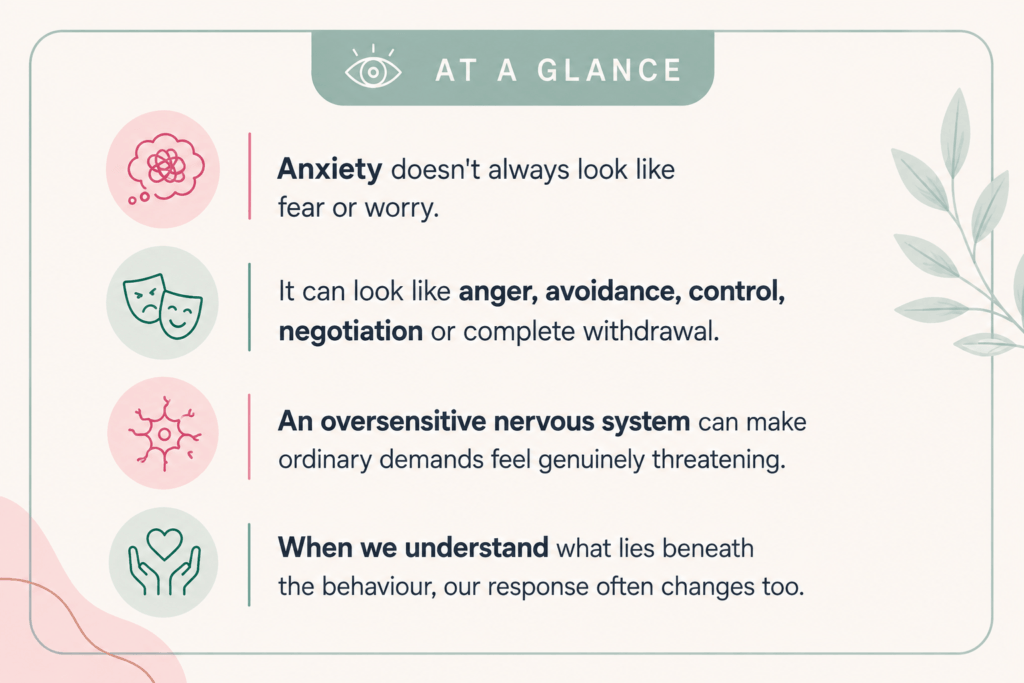
I have always personally struggled with anxiety, so I thought I had a good understanding of how it looks and feels. A racing heart, palpitations, sweating, self-doubt, the list goes on. And whilst anxiety absolutely does look like that for many people, for others it presents disguised as something else entirely.
It may look like:
- refusing
- arguing
- procrastinating
- negotiating
- controlling every detail
- becoming angry
- shutting down completely
- running away
This is one reason why anxiety can be so easily misunderstood. Whilst we often notice the outward behaviour, we don’t always recognise the correct emotion driving it.
An oversensitive alarm system
One way I think about anxiety is as the body’s internal alarm system.
Its job is to keep us safe. When we step into the road and hear a car approaching, anxiety helps us react quickly. When we’re sitting an exam, a little anxiety sharpens our focus. The problem comes when that alarm system becomes extremely sensitive.
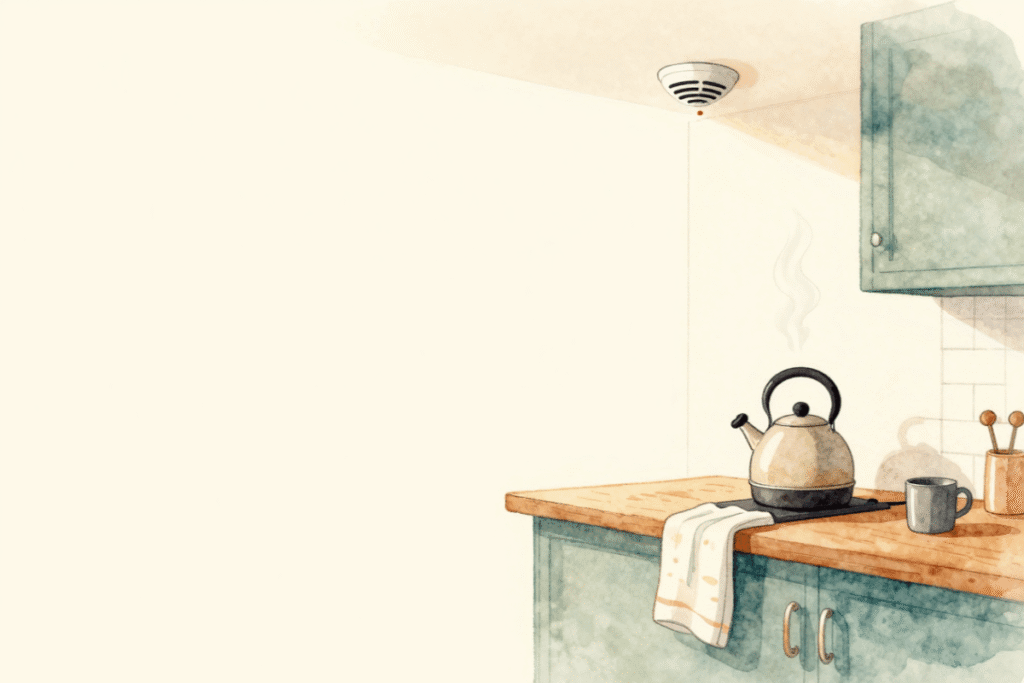
Imagine a smoke alarm that doesn’t just go off when there’s a fire. It also sounds every time someone makes toast, boils a kettle or lights a candle.
The alarm isn’t broken. It’s doing a magnificent job of what it was designed to do, keep us safe. But it can’t always tell the difference between a truly dangerous situation and something that’s actually safe and under control.
For many autistic people, and particularly those with a PDA profile, everyday demands may trigger that same sense of threat. Not because the task is objectively difficult, but because the nervous system experiences it as overwhelming.
Why uncertainty matters
One of the most interesting areas of recent research looks at something called intolerance of uncertainty.
Put simply, this describes how difficult someone finds not knowing exactly what is going to happen. For many of us, uncertainty is a bit uncomfortable. For others, it can feel entirely intolerable.
Questions such as:
“What if I can’t do it?”
“What if something changes?”
“What if I lose control?”
can arise automatically, even when nobody else notices anything unusual. The greater the uncertainty, the greater the anxiety it may cause.
It’s not just uncertainty, the senses play a part too
Uncertainty isn’t the only thing feeding that alarm system. For many autistic children, ordinary sensory input, sound, light, touch, texture, can register as far more intense than it does for others, and that sensory load can add directly to the anxiety picture.
Research looking specifically at this link found that intolerance of uncertainty and sensory sensitivities are closely bound up with one another in autistic children, with uncertainty helping to explain a large part of why some children experience sensory input as so much more overwhelming than others do.
Going back to the smoke alarm: if uncertainty is one thing that can set it off, sensory overwhelm can be another, and sometimes both go off together. A room that feels too loud, a label that feels too scratchy or a light that feels too bright doesn’t just feel unpleasant, it can genuinely register as unsafe. And when the body already feels unsafe, even a small demand layered on top can be the final straw.
This is part of why the same request can feel completely manageable on a calm day, and completely overwhelming on a day when the sensory environment already feels like a lot.
Why demands feel different
This helps explain something that often confuses families. The demand itself is rarely the whole story, it’s what the demand represents. A request from someone else removes a degree of autonomy and certainty. For someone whose nervous system is already working incredibly hard to maintain a sense of safety and predictability, even a small demand can become the final straw.
This also explains why a child may resist doing something they genuinely wanted to do only moments earlier. The desire hasn’t disappeared. The demand has changed how safe it feels.
Through Two Lenses
What people may see:
- “He’s being difficult.”
- “She’s so controlling.”
- “He always has to have the last word.”
- “They just want attention.”
What may actually be happening:
- “My nervous system doesn’t feel safe.”
- “I need more certainty.”
- “I’m trying to regain some control.”
- “I don’t know how to explain what this feels like.”
These two perspectives can lead to completely different responses. One assumes wilful and defiant behaviour. The other recognises a child doing their very best to cope with an intense possibly overwhelming feeling.
How this can change everything
Once anxiety becomes the focus rather than the behaviour, our priorities begin to shift. Instead of asking “How do I make them comply?”, we might ask “How do I help them feel safe enough to cope?”
Sometimes that means reducing unnecessary demands. Sometimes it means offering genuine choices. Sometimes it means allowing extra time or flexibility. Sometimes it simply means recognising that today’s capacity is different from yesterday’s.
None of this removes boundaries or expectations. It simply acknowledges that helping a child regulate their nervous system is often the first step towards helping them meet those expectations.
My own perspective
One of the hardest things about parenting a child with a PDA profile is that the behaviours often look intentional. I know how easy it is to wonder whether they’re manipulating the situation, or simply choosing not to cooperate because they don’t want to, rather than because they can’t. The more I react with inflexibility and try to control the situation the more things will escalate, no-one wins in this situation.
Learning more about anxiety hasn’t made every day easier, but it has made it easier to stay compassionate. It reminds me that beneath the negotiations, the arguments and the avoidance is usually a child whose nervous system is working much harder than most of us ever realise.
That understanding changes how I respond. And often, it changes how my son responds too.
The bit I want you to take away
Behaviour makes much more sense when we understand the nervous system beneath it.
Anxiety doesn’t always look frightened. Sometimes it looks angry. Sometimes it looks controlling. Sometimes it looks like refusing to put shoes on. Sometimes it looks like saying “no” to something we desperately wanted only moments before.
If we only respond to the behaviour, we risk missing the message. When we recognise anxiety for what it is, we begin to see not a difficult child, but a child whose nervous system is asking for safety, predictability and understanding.
That doesn’t solve every challenge overnight. But it gives us a much better place to start.