
What Is PDA? Understanding Pathological Demand Avoidance / Pervasive Drive for Autonomy
The short version
If you’ve landed here because someone mentioned PDA and you’re not quite sure what it means, you’re in the right place. I’m going to explain it both as a GP and as a mum navigating this with my child, because honestly, those two lenses have taught me different things about what PDA looks like day to day.
PDA started life as “Pathological Demand Avoidance”, a term first used in the 1980s by Professor Elizabeth Newson, a developmental psychologist. She noticed that some of the children referred to her for assessment shared many features of autism, but had a presentation that didn’t quite fit the usual pattern. These children were highly avoidant of everyday demands, yet outwardly very sociable, and that sociability often became a tool for avoidance itself. Rather than refusing outright, a child might charm, distract, negotiate, or change the subject to get out of doing something. This combination of avoidance and sociability seemed to be a defining feature of what she was seeing.
This was an important distinction for parents and professionals. Many children with PDA don’t respond well to the more conventional strategies for support, like routines and reward charts, and instead need a different approach to help them thrive.
A note on terminology
The term Pathological Demand Avoidance is now quite contentious, and I agree, it’s a term I don’t feel accurately reflects the condition. “Pathological” sounds very medicalised, negative, and stigmatising. “Avoidance” implies a wilful, intentional refusal, rather than what it actually is: a severe, anxiety-driven response. Because of this, other terms have started to take its place, including Persistent or Pervasive Drive for Autonomy, or simply a “PDA profile” of autism.
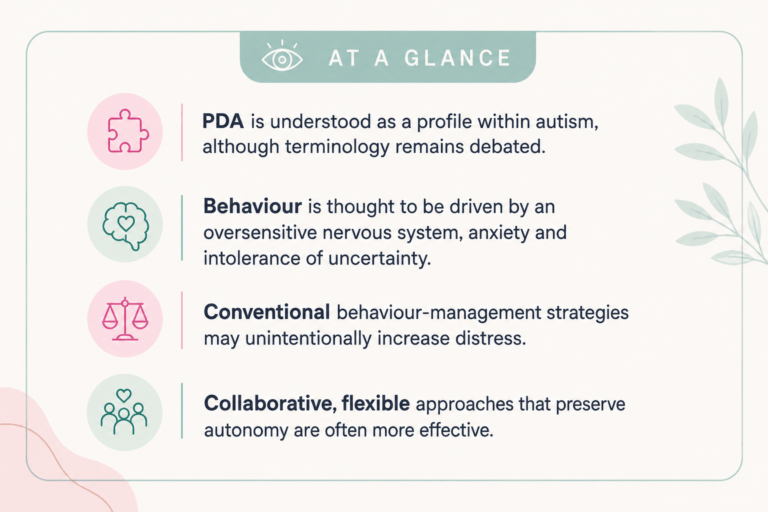
At present, PDA is understood as a profile within the autism spectrum, characterised by an extreme avoidance of everyday demands and expectations, even ones the child wants to do or has asked for themselves. This last part often surprises people. A PDA child might desperately want to go to a friend’s birthday party, and still find themselves unable to get in the car when the moment comes.
This isn’t naughtiness. It isn’t defiance for the sake of it. And it isn’t something a child can simply choose to switch off. PDA is not currently recognised as a standalone diagnosis in its own right, which means it can be met with scepticism, or a lack of awareness from professionals or educators.
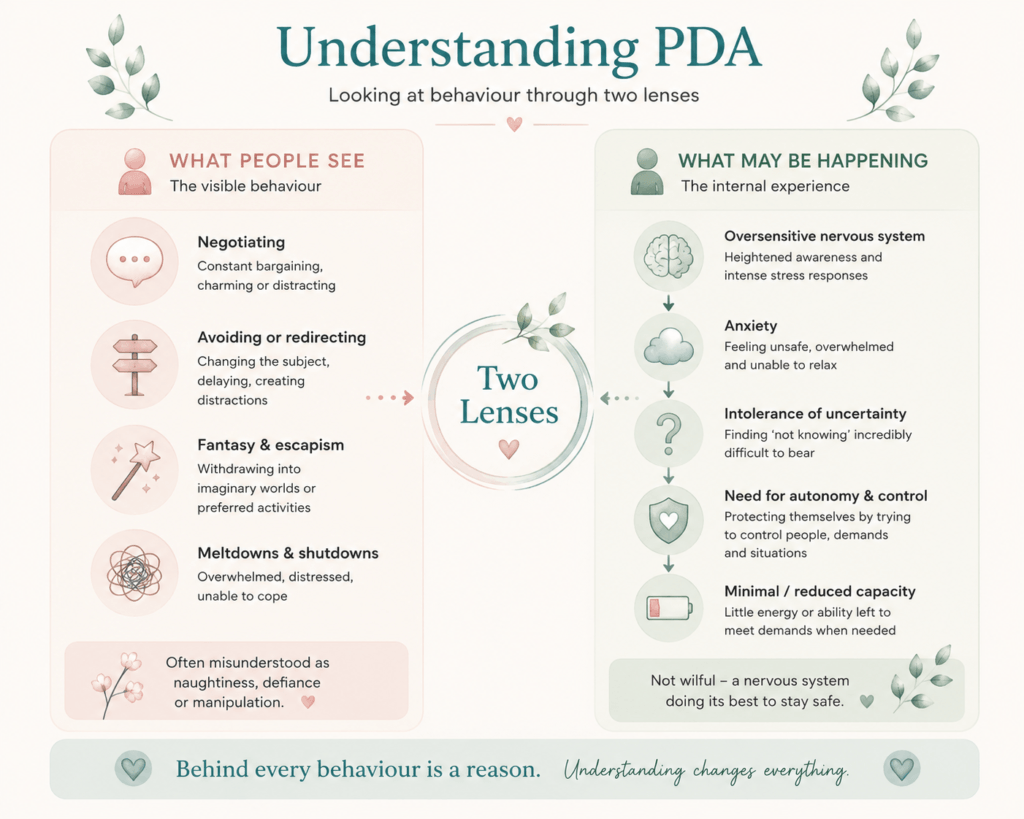
For a long time, PDA was described mainly by its behaviours: the negotiating, the distraction tactics, the meltdowns, the sudden shutdowns. What’s been missing is a clear answer to why.
What drives PDA
A 2019 study by Stuart, Grahame and colleagues, published in Child and Adolescent Mental Health, looked directly at this question. It had long been suggested that demand-avoidant behaviour was driven by an anxious need to be in control, but this had never been explicitly studied before the research.
What they found was striking, and it’s changed how I think about my own son’s behaviour. Their results suggest demand-avoidant behaviour can be understood, at least in part, as an attempt to increase certainty and predictability in order to ease rising anxiety. In other words, the avoidance isn’t really about the task itself. It’s about how unbearable it can feel to face something uncertain or beyond a child’s control, even something small like being asked to put their shoes on.
The researchers described three different ways children coped with this feeling:
- Taking control of the situation, often through negotiating, delaying, or redirecting the adults attention to something else
- Withdrawing into fantasy or imaginative play, stepping away from the real demand into a world they can control
- Reaching a meltdown, when the feeling becomes too much to manage any other way
These weren’t just three types of the same thing. Intolerance of uncertainty, that is, how hard a child finds it to sit with not knowing what’s coming next, was linked to all three coping styles. But when the researchers looked specifically at anxiety, only meltdown was clearly driven by it. This tells us that the various behaviours we see under the PDA umbrella aren’t one single thing. They’re different strategies a child’s nervous system reaches for to manage a feeling of unpredictability that’s becoming too much to bear.
Why this matters before we respond
Once you see PDA through this lens, a lot of the usual parenting or behaviour-management advice stops making sense. Reward charts, strict routines and discipline, firm consequences, “just be consistent” style approaches, these tend to increase demand and reduce a child’s sense of control or autonomy, which is precisely what fuels the anxiety underneath. It’s not that these strategies are being done wrong. It’s that they’re aimed at the wrong target audience.
What tends to help instead, is reducing the feeling of being told what to do. Offering choices, building in flexibility, dropping unnecessary demands, and framing things collaboratively rather than as instructions can lower that underlying sense of threat. None of this is about giving in or having no boundaries. It’s about recognising that for a PDA child, uncertainty and loss of autonomy are experienced as genuinely threatening, not simply inconvenient.
Is all demand avoidance PDA?
It’s worth saying clearly: not all demand avoidance is PDA. Avoiding demands is something all of us do sometimes, and for children in particular there are lots of reasons a request might feel impossible in the moment. Anxiety is a big one, and so are executive functioning differences, where the barrier isn’t “won’t” but “can’t get started”. Sensory overwhelm, perfectionism and fear of getting it wrong, autistic inertia (finding it hard to switch tracks from what you’re doing), ADHD and the very real difficulty of forcing your brain towards a non-preferred task, low mood, exhaustion or burnout, trauma, and simply not fully understanding what’s being asked can all look like avoidance from the outside.
And of course, toddlers and teenagers pushing back against demands is a completely normal part of developing independence. Research backs this up: studies have found that extreme demand avoidance isn’t unique to PDA and appears across a range of conditions and circumstances. What tends to set a PDA profile apart isn’t the avoidance itself but the pattern around it: an anxiety-driven need for autonomy and control that applies even to everyday, enjoyable or self-chosen activities, alongside other features of the profile. So if your child avoids demands, that alone doesn’t mean PDA. It means something is getting in the way, and the useful and perhaps more challenging thing is to find out what that is.
The main take away point
If you’re parenting a child with PDA, you are not imagining how different it feels from typical parenting advice, or even why effective strategies that work well for other neurodivergent profiles don’t seem to help your child. The research is starting to catch up to what many parents already knew from lived experience: this isn’t wilfulness, it’s anxiety wearing a very convincing disguise.
Understanding that has changed how I show up for my child, and I hope it does the same for you. Ultimately, all children, whether they have a diagnosis or not, deserve to be understood, and to have individual, evidence-based strategies that help them thrive.
Continue Reading
If this article resonated with you, you might also find these helpful: